

Is Your Technology Landscape Really AI-Native?
Enterprises are adopting AI quickly. Copilots, generative AI features, AI-assisted search, machine learning models and early agentic systems are appearing across the technology estate.
But having AI does not automatically make the underlying technology landscape AI-native.
Accenture's 2026 research across 2,000 companies found that 64% of respondents had moved advanced AI beyond isolated pilots or begun coordinated enterprise wide efforts, while only 7% qualified for Accenture's highest category of AI-ready data capability. Accenture does not claim that the remaining 93% are entirely unready for AI, but the contrast illustrates a practical problem: AI adoption can move faster than the data, integration and operating foundations required to support it at scale.
So the more useful question is not how much AI an enterprise has adopted. It is whether its technology landscape can put AI to work reliably, securely and repeatedly where AI creates value.
What does an AI-native technology landscape mean?
There is no single industry-standard definition. IBM uses a relatively strict interpretation: AI-native systems are designed around AI as a foundational capability rather than having AI added later as another feature. That definition is useful for new products and applications, but it becomes more complicated for an established enterprise estate.
A large enterprise may run decades old core applications alongside SaaS platforms, ERP, public and private cloud, custom software, APIs, integration middleware, data platforms and new AI services. Rebuilding all of that around AI would be neither realistic nor necessary.
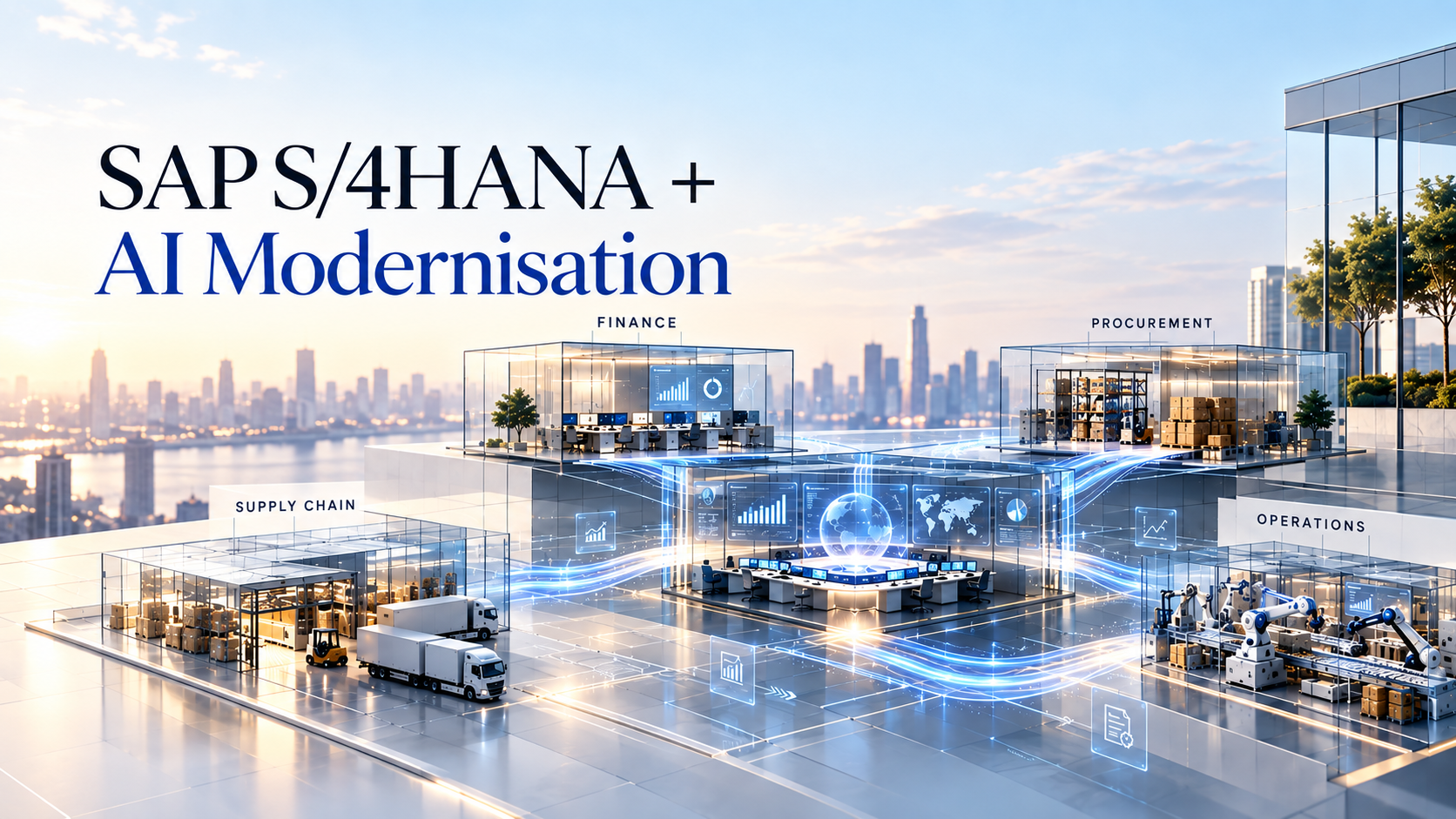
SAP's 2026 AI-Native North Star architecture points to a more practical model: deterministic systems can continue doing the work they do well, while AI-oriented capabilities add context, reasoning and orchestration around them. Existing applications can expose useful capabilities through APIs, events and data instead of being replaced simply because they predate generative AI.
For an established enterprise, an AI-native technology landscape is one in which AI can operate as a first class capability in the workflows where it creates value, supported by the enterprise context, systems, integration, infrastructure, security and operational controls required to use it reliably.
That does not mean AI everywhere. It means the landscape is intentionally designed to support AI where it belongs.
A better test: trace AI through a real workflow
Instead of asking whether every system in the estate is AI-native, choose an important AI-enabled workflow and trace it through the technology landscape. The path quickly exposes whether the surrounding architecture can actually support AI in production.
Consider a hypothetical supplier onboarding process. AI might read supplier documents, extract information, identify missing fields and recommend whether a submission is complete. To do that reliably, several questions must be answered.
Can AI understand the business context?
The system may need supplier master data, procurement policies, previous records, compliance documents, category specific rules and exception thresholds. Accurate data alone is not enough if AI cannot determine which source is authoritative, which policy applies or which exceptions are permitted.
Accenture's AI-ready data research identifies business context and tacit organizational knowledge, not just data quality, as constraints on advanced AI. The requirement is therefore broader than 'clean data': AI needs usable enterprise context.
Can AI reach the systems where work happens?
Can it retrieve an existing supplier record, check whether a tax identifier already exists, create a draft entry or trigger a compliance review? The enterprise may already have every capability the workflow needs, but those capabilities may be trapped behind application boundaries or brittle integrations.
This is why the question is not simply whether the enterprise still has an old ERP. It is whether the workflow can safely use the business capability inside it. SAP's architecture explicitly treats applications as providers of capabilities through APIs, events and data.
What is AI allowed to do?
Reading a document is not the same risk as changing a supplier record. Drafting a recommendation is not the same as approving a supplier. An organization may allow AI to extract information and populate a draft while requiring a person to approve higher risk cases.
The objective is not maximum autonomy. It is appropriate authority for the workflow, based on risk, regulation, reversibility and accountability.
As AI begins interacting directly with enterprise tools, identity and authorization become more important. NIST's current work examines how software and AI agents should be identified, authenticated, authorized and audited when they receive access to enterprise data, tools and applications.
Can the enterprise operate the AI after deployment?
Production introduces questions that a proof of concept can avoid: Is performance deteriorating? Did a policy change? Can a recommendation be traced? What happens when a source system fails? How are costs monitored? Can a person override an incorrect result, and does that feedback improve the system?
Production AI has to be operated as production technology. Google Cloud's enterprise AI guidance similarly emphasizes robust, observable and scalable systems supported by secure data and appropriate infrastructure.
A useful test is therefore simple: can AI move from business intent, to enterprise context, to enterprise capability, to a governed and observable outcome?
Where that path breaks is where the technology landscape shows what needs to change.
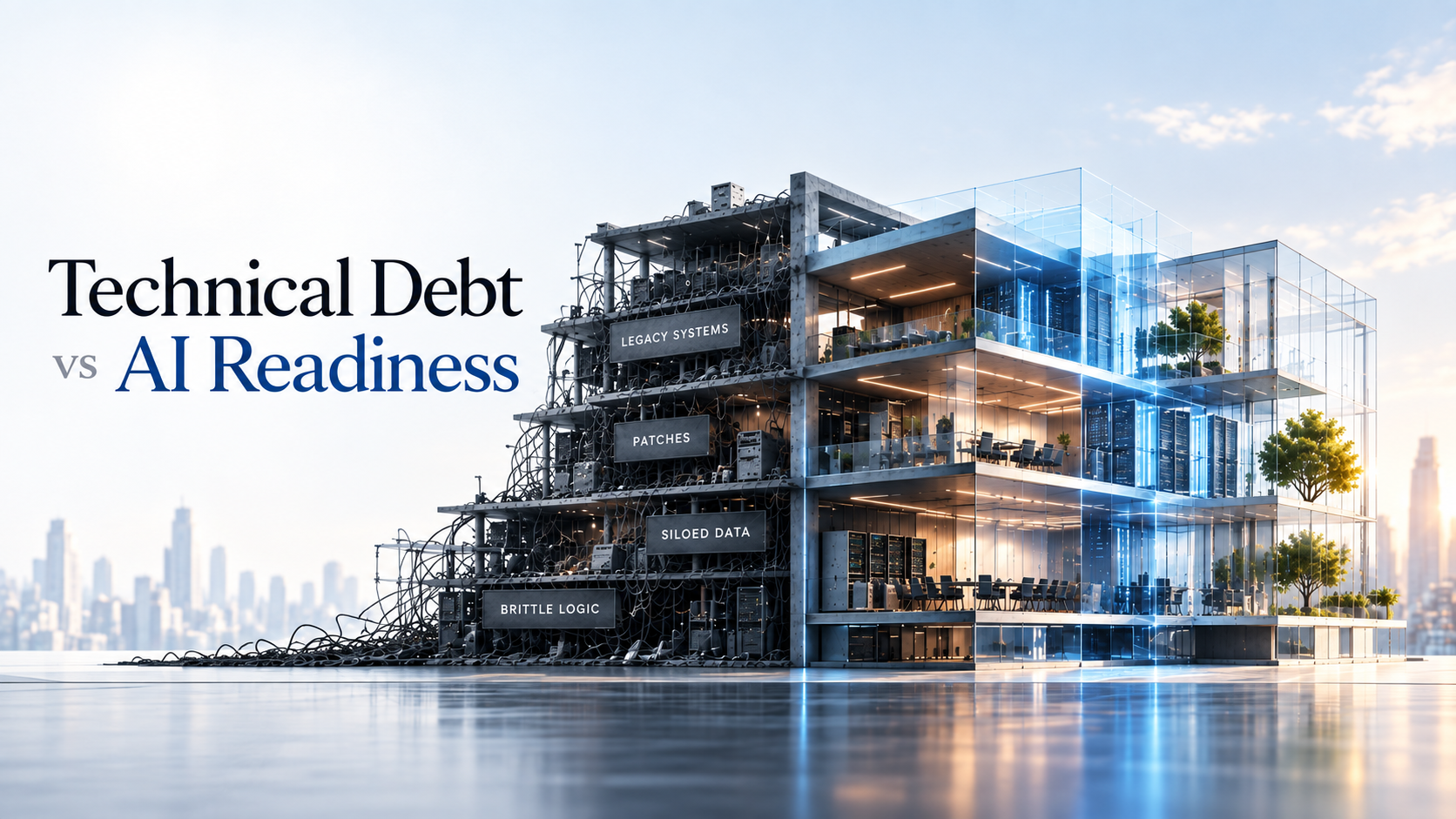
Modernize the constraint, not automatically the system
Once a weakness is identified, the next mistake is to turn every gap into a modernization program.
Kyndryl's 2026 modernization research found that only 9% of surveyed organizations had fully mapped their business-critical applications and dependencies. Kyndryl also reported that the average organization in its study operated hundreds of business critical applications. In environments this complex, replacing technology simply because it is old can create more risk than value.
The better question is: does this component prevent the AI-enabled workflow from operating reliably, securely or economically?
Keep: The system performs its function well and does not constrain the workflow.
Expose: The capability is useful but difficult for AI or other systems to access. Provide an appropriate API, service, event or interface.
Integrate: The required information or process spans several systems. Improve the connection between them.
Enrich the context: The system works, but AI lacks the definitions, metadata, policies, relationships or knowledge required to use its information correctly.
Modernize: The architecture genuinely prevents the workflow from operating reliably, securely or efficiently.
Replace: The cost, risk or constraint of adapting the system is greater than the value of retaining it.
Change the constraint, not automatically the system.
A 15 year old application may continue to perform its core function extremely well. If AI only needs controlled access to one capability inside it, an interface may solve the problem. Another system may need deeper modernization. A smaller number may genuinely need replacement.
Do not let AI projects create a new generation of silos
A workflow-led approach has one obvious risk: every team can build its own model access, retrieval stack, security controls, evaluation tooling, observability and deployment process. The enterprise solves individual use cases but creates a new architecture problem.
This is where reusable foundations become valuable. HCLTech's platform engineering perspective emphasizes shared services, standardized engineering paths, governance and observability as organizations move from experiments to repeatable production AI.
The sequencing matters: start with the workflow, then standardize what repeatedly becomes common.
If several AI solutions need the same model gateway, retrieval service, identity pattern, evaluation tooling, observability or deployment controls, those capabilities become candidates for shared enterprise infrastructure. That repeatability is a stronger sign of an AI-native landscape than the number of AI pilots underway.
AI-native should not mean AI everywhere
Traditional deterministic software remains better for many predictable, rules based tasks. Some workflows may allow AI to complete routine actions automatically; others should use AI only to assist a person. Some decisions should remain firmly under human authority.
SAP's architecture explicitly preserves deterministic processing alongside probabilistic AI rather than assuming one should replace the other.
AI-native therefore should not be measured by how autonomous the enterprise becomes. A better measure is whether the technology landscape can support the appropriate level of AI for each workflow, with the context, controls and reliability that level requires.
So, is your technology landscape AI-native?
Counting copilots, models, AI features or agents will not answer that question. Choose an important business workflow and follow AI through the technology required to make it work.
Can AI access and interpret the business context it needs?
Can it use the enterprise systems and capabilities required to complete the work?
Does it have the appropriate level of authority?
Can the resulting system be secured, evaluated, observed and improved in production?
Where those answers break down, the landscape is showing you what needs to change. For an established enterprise, becoming more AI-native is less about rebuilding the estate and more about deliberately redesigning the parts AI depends on while preserving the technology that still works.
As those patterns repeat, common capabilities can be standardized into reusable foundations that make future AI implementations faster, safer and easier to operate.
The goal is not to rebuild the enterprise for AI. It is to create a technology landscape in which AI can become dependable production technology wherever it genuinely improves how the enterprise works.